
Over the past 18 months, I’ve been immersed in the legaltech ecosystem. I’ve spoken to more than 50 practicing lawyers, from large law firms to boutique practices and solo operators, and over 100 founders building the next generation of legal infrastructure.
There’s been one consistent debate: the future of the billable hour.
Often, it appears in conversations about AI-driven margin shifts, how pricing should evolve with automation, and client tolerance for open-ended billing.
Founders building legal AI tools are taking clear positions in today's version of that debate through their product offerings and pricing models. Some help firms capture and document more billable time, while others automate timekeeping altogether. Others are pushing firms toward flat-fee or subscription-based pricing models.
The lawyers I spoke to acknowledged the systemic inefficiencies but also recognized how deeply the billable hour is woven into firm economics and how hard it will be to unwind it.
The billable hour has shaped firm staffing, pricing, and productivity measurement for decades. But that model continues to be under pressure across the stack. Clients are more cost-sensitive, AI is compressing the time required for many legal tasks, and law firms are forced to justify their fees and explain why they charge what they do.
As AI speeds up and makes routine legal work more predictable, that type of work is moving toward flat, subscription, and hybrid pricing models. At the same time, complex, high-uncertainty matters continue to be billed hourly, dividing what was once a more unified billing structure.
This shift matters because legal services represent a roughly $900 billion global market. Even modest AI-driven efficiency gains of 10%–20% in key workflows translate into enormous economic value. The real question is not whether work gets faster, but who ultimately captures the efficiency dividend.
Evolution of the billable hour
It's worth remembering that this isn't the first time the billable hour has faced an existential question. The model survived innovations like the fax machine, email, video conferencing, and electronic signatures, each of which fundamentally changed how legal work was done. During the first wave of legal tech innovation in the 1970s and 80s, tools like Westlaw and LexisNexis fundamentally changed how lawyers did research. What once required hours in a law library could be done in minutes. But the efficiency dividends didn't flow to clients. Firms captured it, and billing rates continued climbing.
The same pattern played out in the 2000s with document management and e-discovery platforms like Relativity and practice management tools like Clio that digitized workflows, including client intake, matter management, time tracking, and billing. Each wave made lawyers more efficient, but the economic surplus largely remained within the firms.
What makes the current wave different is the type of work that AI is enabling. Prior tools optimized around the lawyer: better research retrieval, faster document organization, cleaner invoicing. They made lawyers more productive but left the core work untouched. Today's AI tools are beginning to do the work itself (e.g., drafting, reviewing, analyzing, summarizing) and encroaching on billable tasks. Clients are more aware and emboldened to demand that efficiency be reflected in pricing changes.
Whether history repeats itself, or whether this wave finally redistributes the dividend, is the defining commercial question of the next decade.
Clients now want predictability, not just expertise
Across corporate and individual clients, expectations have shifted toward predictability, transparency, and alignment between price and value. In-house legal teams grapple with tighter budgets and more scrutiny from their CFOs. Small businesses and individuals are comparing the cost of legal services to other professional services that already offer fixed pricing models.
The hourly billing model, by design, struggles here. It transfers risk to the client because the final cost is unknown until the work is entirely done. Even when clients trust their lawyer, they dislike the cost uncertainty.
Firms increasingly feel pressure to answer one question upfront: What will this cost?
In the short term, AI may expand margins. If a task drops from 10 hours to 6 hours while pricing holds, profitability widens. Early adopters may benefit significantly before clients fully recalibrate expectations. That window won’t stay open for long as prices adjust across the market over time.
Where flat fees are gaining ground: Simple, repeatable legal work
This shift away from variable billable hours is most visible in routine legal work: tasks that are relatively standardized, predictable, well-scoped, and increasingly supported by templates or AI tooling like:
- NDAs and basic commercial contracts
- Employment agreements and offer letters
- Uncontested divorces
- Simple estate planning documents
- Business formations and compliance filings
For this category of work, firms can reliably estimate effort and risk. That makes flat fees and subscription models not just viable, but compelling as efficiency improves margins rather than cannibalizing them.
For clients, flat fees provide certainty. For law firms, they reduce billing friction, speed up collections, and reward efficiency.
Tasks that once consumed hours, like document review, compliance filings, and first drafts, now take a fraction of the time. But faster work means fewer billable hours, and that creates immediate tension.
Flat fees resolve that tension, allowing firms to adopt technology without eroding revenue. But the evolution is not simply hourly versus flat. More commonly, firms are adopting hybrid models:
- Hourly billing with caps
- Blended rates across seniority
- Success fees layered onto hourly fees
- Portfolio pricing for repeat clients
Technology gives firms the option to rethink pricing, especially when the work itself has become more predictable. The shift is incremental, as risk is being redistributed rather than eliminated.
How AI is reshaping the future of law firm economics
Traditional law firm economics rely on a pyramid:
- A small number of partners
- A larger group of senior associates
- An even larger base of junior associates and paralegals
AI today disproportionately compresses the work historically performed by junior associates, like document review, research, and drafting first passes.
The conventional assumption across markets today is that junior associates and paralegals are the most replaceable and therefore most at risk. But when you dig into it, they may not be the most profitable tier. Junior associates are expensive to recruit, train, and supervise, and while their billing rates are lower, that doesn’t always offset the overhead and ramp-up time they require. Paralegals also bill at rates that are structurally capped and have long functioned more as a cost-management tool than a profit center.
The highest-margin work in most firms is concentrated in the mid-level associate tier (think third through sixth year associates). These attorneys have moved past the learning curve, bill at meaningfully higher rates, and operate with far less supervision. They're efficient enough to be productive without being expensive enough to make clients balk. If AI compresses their hours—not just the routine work that juniors handle, but the more substantive research synthesis, issue-spotting, and drafting that mid-levels own—the margin impact could be more acute than expected.
This raises new questions. If the junior associate pipeline shrinks, how do firms develop future partners? And when AI reduces billing hours for the mid-level tier, profitability could come under real pressure.
The billable hour still dominates complex legal work
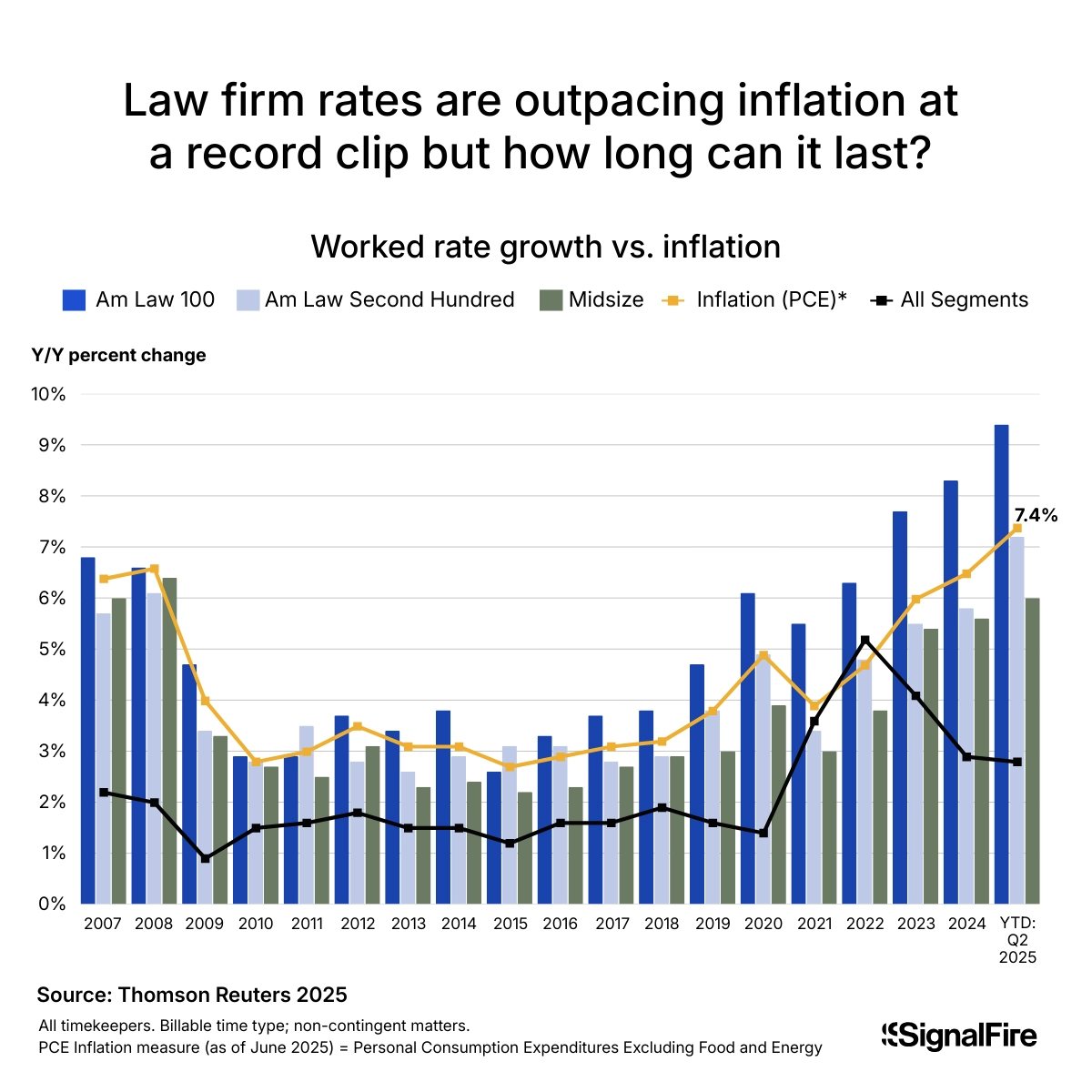
Despite all of the momentum around alternative pricing, the reality is that the billable hour remains deeply entrenched in more complex, high-stakes, or open-ended legal matters. As revenues now depend more on pricing power than on actual demand, clients are pushing back and routing work to cheaper alternatives, and balance sheets are showing early signs of stress.
The Thomson Reuters Institute's Law Firm Rates Report 2026 digs into this tension, revealing that while firms have rushed to invest in AI to justify higher rates, a counterintuitive finding emerges: Regardless of whether firms discount aggressively or hold firm on realization, they’re collecting roughly the same amount per hour, leaving firm leaders to grapple with where competitive advantage actually lives.
- Mergers and acquisitions
- Bet-the-company litigation
- Regulatory investigations
- Complex commercial disputes
- Long-running class actions
The underlying reason for hourly billing here is uncertainty. In these types of matters, the scope keeps evolving, numerous factors are at play, and the risk is asymmetric and dynamic.
Pricing these engagements upfront requires embedding significant risk premiums, which often makes fixed-fee structures impractical. Clients pay for the effort as it occurs, and firms are protected if the matter expands beyond initial expectations.
Even clients who advocate for alternative pricing frequently revert to hourly billing when the stakes are highest. When downside risk is significant, outcomes matter more than predictability. In those moments, clients care about securing the best legal representation and are willing to set aside their preferences to maximize the probability of achieving their desired outcome.
The likely end state: A hybrid legal economy
The future of legal pricing looks less like a single model and more like a diversified pricing stack, where flat, hybrid, and billable structures coexist, each matched to the nature of the work being done.
The more strategic question is who captures the value created by AI-driven efficiency?
- Does the firm expand margins?
- Do clients negotiate lower fees?
- Do software vendors absorb the economic surplus?
Firms that align pricing with the nature of their work, and honestly assess where AI accelerates execution versus where human judgment is irreplaceable, will be best positioned to compete.
The result isn’t the death of the billable hour but its relegation to the work that actually warrants it, alongside an expanding menu of alternative structures that didn't exist at scale a decade ago.
At SignalFire, we back founders who understand that the real moat isn’t just workflow automation, it’s proprietary data, embedded expertise, and defensible training loops. If you’re building AI tools that reprice, restructure, or rethink how legal work gets done, we want to hear from you. Email me at aayush@signalfire.com.
*Portfolio company founders listed above have not received any compensation for this feedback and may or may not have invested in a SignalFire fund. These founders may or may not serve as Affiliate Advisors, Retained Advisors, or consultants to provide their expertise on a formal or ad hoc basis. They are not employed by SignalFire and do not provide investment advisory services to clients on behalf of SignalFire. Please refer to our disclosures page for additional disclosures.
Related posts

Build or buy? Navigating the new era of GTM AI Agents

Why the future of Fintech belongs to industry-specific financial tools


Unicorn DNA — Where today’s billion-dollar startup founders come from