

A year ago, building a custom agent to handle a GTM workflow at a startup meant a quarter of engineering time, a contractor budget, and founder conviction to see it through. Today, one operator can ship something in a couple of days that would have cost $10,000-$40,000 to scope and build in 2023. The economics have flipped, but most founders are still budgeting like it's 2023.
This matters because the old "build vs. buy" calculus was built for the old cost curve, when every custom tool required real engineering investment. Now the default has shifted for an entire class of workflows, and the teams who see that first will run faster GTM motions with a smaller headcount. While off-the-shelf SaaS tools offer speed, they often lack the nuance of a company’s specific DNA. Leveraging today’s LLMs lets small teams build tools that fit their needs, not the other way around.
Having spent the last year building custom GTM agents at Together AI and Resolve AI, here's the heuristic we've landed on, four examples of how it plays out in practice, and what we'd tell an early-stage founder asking where to start on Monday.
The heuristic: Buy the system of record, build the edge
Pay for anything that touches your core data or security posture, like a CRM, marketing automation, billing, identity, and observability for production services. These are systems of record that need to be stable and auditable, and there's already a mature vendor who does it better than your team will be able to on a side quest.
Build anything that reflects how your company actually operates, specifically the peripheral workflows where your context matters more than industry-standard features. For example, outreach research, internal training, forecasting narration, and pipeline health checks. These are where a generic tool flattens your advantage and a custom agent sharpens it.
Try this simple test: If the workflow breaks, would it trigger a security review? If yes, then buy it. If the workflow breaks and it would just annoy your SDRs for a day, it's a candidate to build.
Three other factors that shape the call:
- Upfront cost and time. Custom builds now run hours to days for narrow workflows, not months.
- Maintenance. Custom means you own the upkeep. Vendors amortize it across their customer base.
- Sensitivity of the data. If the agent touches customer financial records or production infrastructure, default to buy or to a vendor-reviewed internal build.
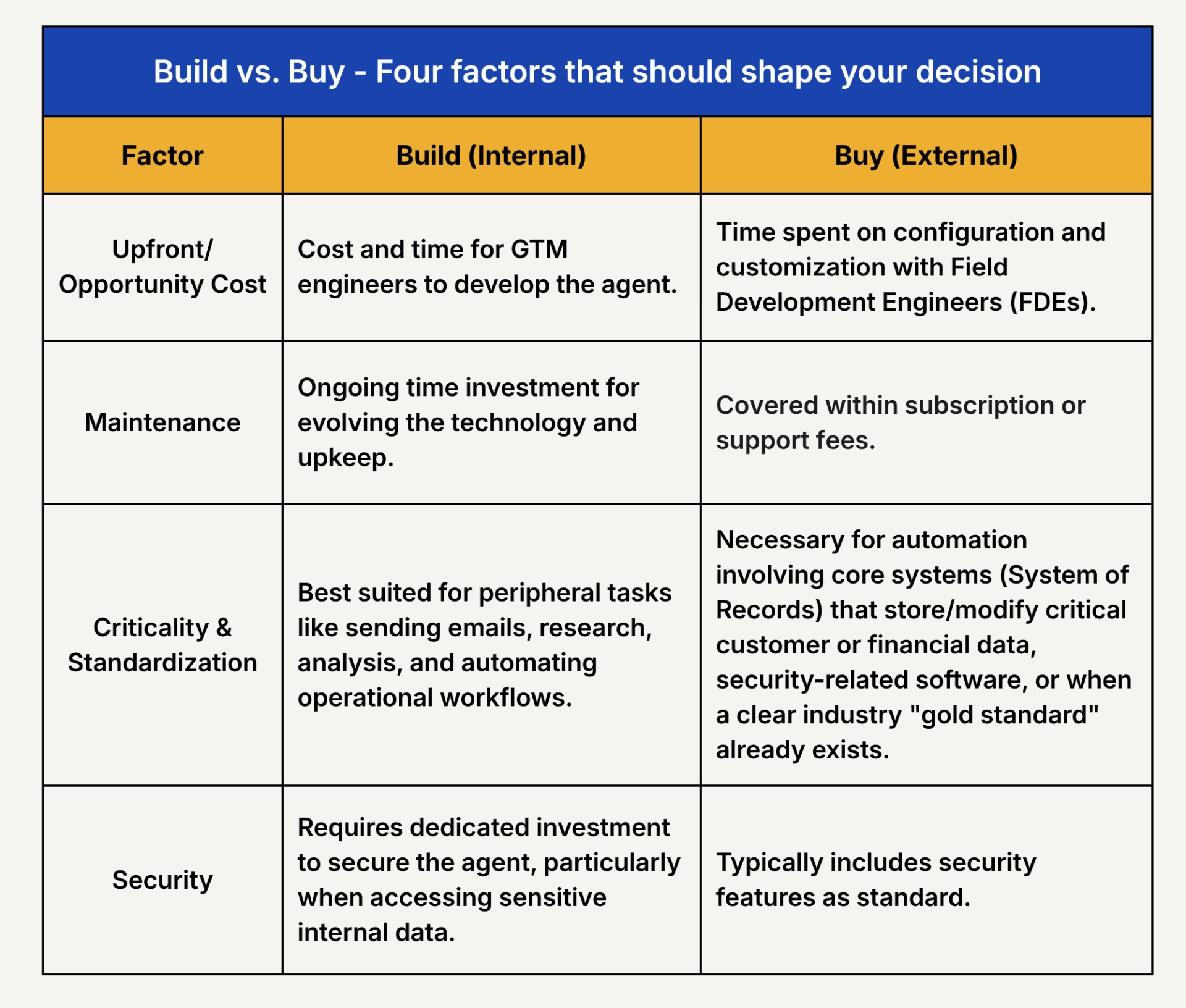
Here is a look at some of the agents built at Together AI and Resolve AI:
1. The Outreach Partner (Outreach Precision System)
Most sales outbound fails for two reasons: you don't know enough about the prospect, and/or you're reaching out at the wrong time. While paid tools can provide general "buyer intent" data, they often miss the signals in plain sight on public platforms.
To move beyond generic data scraping at Together AI, we built a specialized agent to automate the discovery phase. This agent watches for signals specifically relevant to Together AI's business, synthesizes them into a succinct brief, and pings the Sales Development Representative (SDR) when it's worth reaching out and who to reach out to. These signals include recent social media commentary on AI infrastructure/inference from key ICPs within the target companies, updates to GitHub repositories, or shifts in a company's strategic priorities.
A single engineer built it in two weeks. The total build cost was under $100, using open models such as DeepSeek, Kimi, and Qwen via Together AI APIs. The agent now saves each SDR roughly two to three hours of daily research time.
We built it ourselves because it wasn't business-critical, it didn't touch sensitive data, and no off-the-shelf tool encoded the signals that matter for our specific market.
The Result: Our SDRs can reach the right prospects at the right time with a message grounded in what those prospects actually care about.
2. The Interactive Training Agent (Customer Simulator)
There's no substitute for reps on real calls, but burning live deals to figure out your pitch is an expensive way to learn.
To solve this, we built an AI agent that serves as a simulated prospect and a collaborative practice partner. SDRs can role-play with different personas, from a skeptical technical lead to a time-starved executive, using our defined objection-handling frameworks baked into the prompt. The agent scores their pitch delivery and flags where the discovery weakens. Team members can sharpen their delivery and refine their tone before the stakes are real.
A weekend of coding with no sensitive data involved. Off-the-shelf roleplay tools exist, but ours trains against our playbook rather than a generic one.
The Result: SDRs ramp faster, proactively enhance their product knowledge, and get a measurable score to improve against, without burning real pipeline.
3. The Forecasting Agent (Probability Machine)
Monte Carlo simulation on pipeline isn't new. Several vendors sell it, and plenty of sophisticated ops teams have built their own. We did too with thousands of iterations across every open deal, stage-specific conversion rates from our own close history, and a slip model that accounts for the reality that most won deals don't close in their original quarter. That's now table stakes.
What's interesting is what happens when you add an agent to the mix. The simulation runs daily, and the agent surfaces patterns on Monday that a human would probably catch on Thursday, like deals clustering their push dates in the same week, a single deal representing outsized concentration risk, and S2 creation velocity quietly falling behind next quarter's coverage target. It delivers a natural-language briefing before your pipeline call, including what changed, why it matters, and what to do about it.
The agent's job isn't to generate the forecast, but to serve as the warning system and explainer, working only on the data the simulation produced. Keeping its scope that narrow is what makes it reliable and effective.
The Result: Our pipeline calls now start with a one-page briefing rather than 40 minutes of ops triage.
4. The RevOps Observability Agent (Nervous System)
Observability has been standard practice in engineering for a decade. Still, tools like Datadog, Grafana, and PagerDuty were built for teams with dozens of engineers running services where even minutes of downtime cost millions.
For a small RevOps team, the overhead was never justifiable, but the failure modes are just as real. A Fivetran connector fails at 2 am, a staging table goes stale, enrichment stops firing, and by morning, you've routed 50 MQLs without scores, and nobody noticed because every individual dashboard still looks green.
AI-assisted development changed the economics. A single operator can now wire up health checks across the entire GTM data pipeline (CRM, marketing automation, enrichment, reverse ETL, product analytics) in a fraction of the time it used to take.
We run 15 checks every 5 minutes, plus a process assertions layer that catches business-logic failures the infrastructure monitoring misses.
Is lead routing actually firing?
Is the enrichment fill rate above threshold?
The agent sits on top and handles correlation and triage. It traces a single upstream failure downstream to the stale table, the failed assertion, and the under-scored leads that resulted. It knows which errors are noise and which are novel.
The Result: A GTM tech stack that is far more robust and functional and that tells you when something is broken before your CRO does.
A practical starting point for Seed and Series A teams
- Buy for systems of record and build for differentiation: Purchase off-the-shelf solutions for standard functions such as CRM, security, and financial data to ensure stability and standardization. Reserve custom builds for peripheral workflows like research, analysis, and operations that directly reflect your company's unique voice, judgment, and DNA.
- Use agents as a narration layer, not a calculation layer: Don’t rely on AI to generate forecasts. Use deterministic math for the core calculations, and put an agent on top as a narrative layer to explain what moved and why. This allows the agent to provide natural-language briefings on patterns such as deal clustering, push dates, and shifting pipeline risks.
- Don't automate what you can't observe. The same drop in costs that now lets a small team build agents also allows them to build the checks that watch them. Before deploying anything, you should be able to answer three questions:
- What did it do?
- What did it use?
- Did it actually work?
A Slack channel where the agent logs its output counts, as long as someone actually looks at it. The automation nobody watches is the one that quietly sends garbage to your best accounts for weeks.
- Revisit every workflow you've been tolerating. Previously, any automation had to clear a high bar that required weeks of painful, repetitive engineering work. But costs just fell off a cliff, and many founders haven't recalculated. Activities that were historically too expensive to automate, such as pre-call research, pipeline hygiene, weekly reporting, and onboarding prep, are easily automated with a modest investment in internal development.
One last thing
The real unlock isn't that agents are getting smarter, but that building them got way cheaper. Treat the cost collapse as permission to automate the annoying things on your team's plate that weren't worth a Jira ticket six months ago. The teams that figure that out first will outperform the ones waiting for a vendor roadmap to catch up.
Build the ten things your team has been complaining about for months. That's where to start.
Tools we actually use: Cursor, Claude Code, Lovable, Key APIs for Salesforce/HubSpot (CRM or Marketing Automation platform API access), Together AI APIs for open models, and online guides to build agents.
*Portfolio company founders listed above have not received any compensation for this feedback and may or may not have invested in a SignalFire fund. These founders may or may not serve as Affiliate Advisors, Retained Advisors, or consultants to provide their expertise on a formal or ad hoc basis. They are not employed by SignalFire and do not provide investment advisory services to clients on behalf of SignalFire. Please refer to our disclosures page for additional disclosures.
Related posts

SignalFire leads Vector's $10M Series A with HubSpot Ventures to build the first contact-level ad automation platform for B2B
Why the future of Fintech belongs to industry-specific financial tools
Why the future of Fintech belongs to industry-specific financial tools
Conference marketing for startups: How to drive real ROI on a lean budget
