AI in the workplace is no longer a future state but an operating reality. The discourse has devolved into noise with headlines generating varied reactions, hot takes, and uncertainty.
Through our Talent Bonfire series, we brought together a core group of talent leaders to cut through the noise and discuss what’s actually changing.
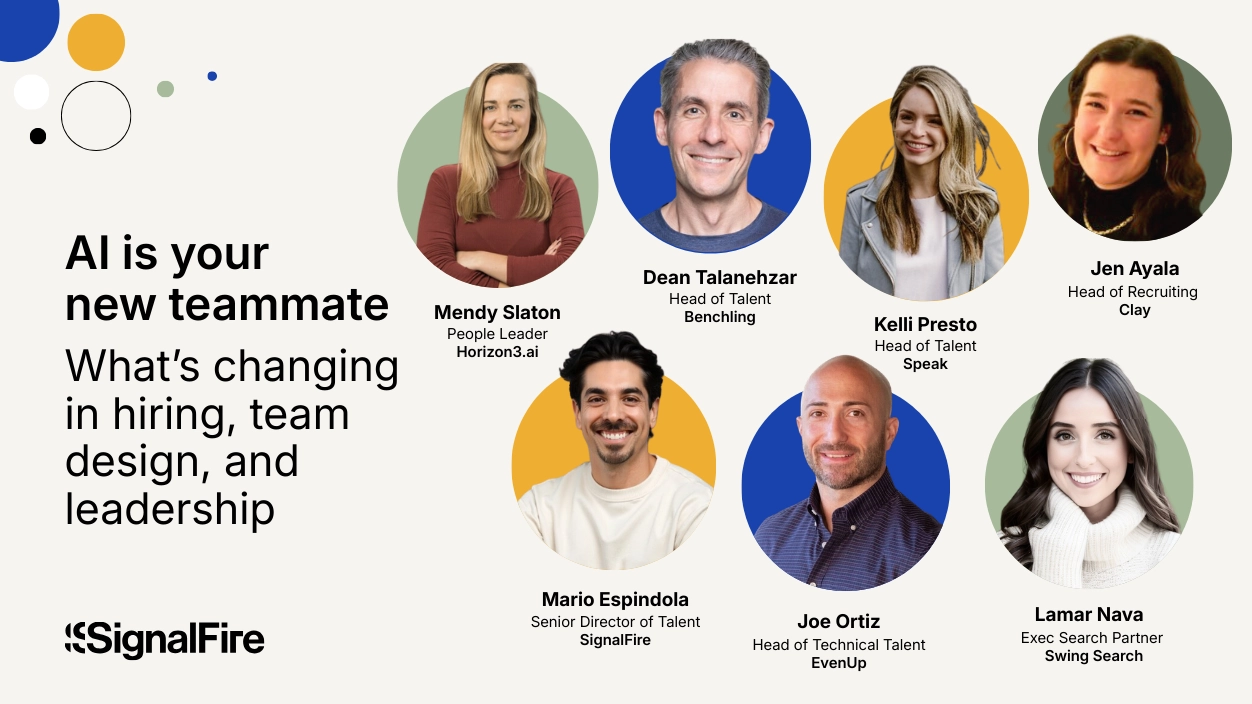
The conversations featured:
- Mendy Slaton, People Leader at Horizon3.ai
- Dean Talanehzar, Head of Talent at Benchling
- Kelli Presto, Head of Talent at Speak
- Jen Ayala - Head of Recruiting at Clay
- Lamar Nava - Exec Search Partner at Swing Search
- Joe Ortiz - Head of Technical Talent at EvenUp
- Mario Espindola - Senior Director of Talent at SignalFire
Our discussions centered on one urgent question:
“If AI is now your teammate, how does that change who you hire, how you structure teams, and what top talent actually means?”
That question is reshaping talent strategy in real time.
As AI use accelerates, workforce planning must become dynamic
The intention behind AI-powered workflows is to drive greater predictability. But today, in what is surely still the early innings, talent leaders are seeing:
- Capabilities are shifting quarter over quarter
- Recruiting tools are evolving drastically and quickly
- Entire functions are experimenting and recalibrating in real time
While targets and headcount plans are still being set, Talent leaders are openly acknowledging that those targets may shift more quickly. Headcount conversations now include a new question:
“What can AI handle today and what still requires human judgment?”
Hiring is still happening and at a fairly rapid pace, but the reflex to automatically backfill roles has shifted. What used to be a default decision is now far more scrutinized.
Dean Talanehzar of Benchling summed this up: “Workforce planning is changing, and traditional work structures may need to be broken to move fast enough to keep up.”
The bar for top talent hasn't changed, but the baseline has
Deep functional expertise still matters, but as AI tooling evolves, so do the skills that set candidates apart. That shift is pushing hiring conversations toward adaptability, curiosity, and learning velocity.
Jen Ayala, Head of Recruiting at Clay, shared her take: “The fundamentals of what makes a great candidate haven't really changed. Most companies still want to hire people with low ego who learn quickly, and want to have an impact beyond their job description. What has changed is that "learns quickly" now means picking up AI tools with fluency and confidence.”
Jen also shared a story about interviewing a recruiter who, mid-exercise, asked if she could use ChatGPT. Jen said yes and then watched her pull up an agent, drop in a data table, and start working through the problem in real time. A year ago, that kind of move might have felt like cheating, but now it's a signal of on-the-job resourcefulness.
Joe Ortiz, who leads technical recruiting at EvenUp, offered a counterpoint. In his work with engineering stakeholders, hiring managers still prioritize raw fundamentals and core technical skills beneath the AI tooling. To them, those foundations remain table stakes for making strong hiring decisions.
Joe also described how EvenUp realized that building a custom AI product for a customer isn’t enough. Adoption doesn’t happen automatically. You need someone from your team embedded early, sitting with the customer, guiding them on how to use the product, and helping them operationalize it in that first month.
That’s the role of a forward-deployed engineer: part engineer, part enabler.
A question from the audience cut straight to the long-term risk: “If companies are hiring 60% fewer entry-level employees today, who becomes the directors five or six years from now?” These experts believe that companies that invest in early career talent today will be in a fundamentally more advantageous position later. For example, Clay is already building a go-to-market rotational program designed to develop the next generation of technical operators.
This is also why Kelly’s team at Speak is leaning into soft skills more than ever: in six months, the job description will change, but the mindset won't. “The hard skills on the AI side will continue increasing, but we’re so early-stage right now that we may have to take some risks on the soft skills side to ensure future success.”
That shift in what 'learns quickly' means has a direct implication for how you interview candidates.
Balancing tool fluency and cognitive agility
On the topic of hiring recruiters, the consensus was clear: don’t assess solely for proficiency in specific tools. Instead, evaluate for the skills that help candidates feel genuinely drawn to the company, its mission, and the work itself.
Lamar Nava, who runs executive search at Swing, put it bluntly: “The tool you assess for today will look completely different in three months.” She's seeing the same thing with RevOps and Sales Ops roles, where scorecards were built around tech stacks that were already outdated by the time a new hire started.
Joe described how a self-directed recruiter at EvenUp built AI-powered automations (such as newsletters that aggregate funding and layoff data, and a capacity planning model) using Gemini. That kind of initiative comes from a mindset, not tooling.
When Jen interviews recruiters, she always asks about the friction in their day-to-day lives. The best candidates can name it, own it, and find ways to automate it with AI.
Where AI delivers value and where it still falls short
Lamar mentioned she's tried nearly every AI sourcing tool on the market and hasn't found one she loves yet. Her team is currently using Noon but wishes it were more mature.
Jen uses Clay (naturally) paired with Harmonic, which she described as solving a career-long frustration of adding real company context to a candidate's resume so you can understand not just where they worked, but what stage the company was at, how much they had raised, and what that experience actually means.
At EvenUp, Joe's team uses Juicebox for sourcing and has leaned into AI for intake meetings, debriefs, and offer packet creation, automating the operational weight so recruiters can focus on relationship-building and closing.
Noon, Harmonic, Juicebox, and BrightHire all got shoutouts, but the consensus was that no single tool has yet cracked the whole vision, especially for sourcing.
The tooling gap also points to a bigger issue: using the technology isn't the most challenging part. Even when the right tools for your needs exist, someone still has to make the case internally for adopting them, manage the anxiety around the implementation, and get every function moving in the same direction.
But AI-native leadership is a tough balancing act. Security teams want guardrails, engineering wants to move fast, and finance teams want proof of ROI. Someone has to hold all of that together, and increasingly, that someone is the People or Talent leader.
Messaging matters too. "AI is your new teammate" lands very differently depending on how it's framed. The goal isn't to minimize the shift, but to better contextualize it. AI raises the performance ceiling, and the expectation for humans doesn't go away; it goes up.
Candidate experience now includes your stance on AI
If you're AI-native and you encourage candidates to use any tool at their disposal, that's a signal. If you're still treating AI usage as a red flag, that's a signal too, and candidates who are fluent with these tools may read it as a mismatch.
Joe described how EvenUp leans hard into human touchpoints to counterbalance its “no AI in assessments” policy, with mini debriefs after every interview stage, on-site visits for local candidates, and taking finalists out to lunch before extending an offer. The human element is the differentiator.
The Clay team runs scorecards through an AI tool to surface details, such as a candidate who completed their PhD thesis on a particular author. The Clay team found a first edition copy of that author's work and sent it to the candidate. That's the kind of thoughtful, creative touch that helps close offers.
Recruiting teams are getting smaller and smarter
All our panelists are running leaner recruiting operations than they were a few years ago. Joe's 20-person team at EvenUp supports 550 employees and 210 open roles. They manage this with just two coordinators and three sourcers. Everyone else is a full-lifecycle recruiter.
Jen shared that her team at Clay is now 18 people and continuing to grow. She recently added a recruiting coordinator not just to manage logistics, but also to help unlock a busy recruiting team. They’re involved in interview prep, building and refining scorecards in Ashby, and even contribute to sourcing.
The day-to-day of a recruiting coordinator (RC) in 2026 looks nothing like it did five years ago. Jen sees the role as part RC, part talent workflow architect. The same goes for People Ops, which complements the TA function.
When it comes to figuring out how much more productive each hire can be with the right tools and automation, Mendy Slaton of Horizon3.ai shared a meaningful hack:
“One of the first things I did that feels like table stakes now is we built an HR bot that responded to all of our tier 1 questions. It reduced our ticket volume by 50%, which really caught people’s attention. It might mean I don’t need that person, or it may also mean that I use their expertise on more complex tasks instead of spending hours a day responding to basic questions.”
Support and administrative roles, like recruiting coordination, tier-one People Ops, and reporting, are often the first to be reexamined as AI automation advances and team sizes compress. Because these functions are highly systemizable and repeatable, they naturally become starting points for workflow redesign and for operating at the forefront of automation.
The work just evolves: Execution shifts towards orchestration, systems thinking, and higher-order problem-solving. Instead of simply managing tasks, these roles increasingly design and optimize the workflows that power the function.
Capacity planning needs a refresh: Joe shared his model: build to 85% of projected headcount needs, and leave a 15% cushion. That buffer can absorb mid-quarter headcount dumps (which seem to happen every quarter) or be bolstered by AI-assisted efficiency gains.
Joe’s team is currently building a capacity planning tool that models recruiter utilization at a more granular level, factoring in the percentage of work that’s AI-assisted versus fully hands-on. Traditional capacity models never accounted for that distinction, and as AI absorbs more operational lift, the old formulas start to break down.
The takeaway: As AI-assisted workflows continue to improve, capacity planning becomes more dynamic. Headcount models will need to flex in real time to reflect how work is actually getting done, not how it used to be done.
Why upskilling your team matters now more than ever
Adopting AI productivity tools is step one, but it’s not a simple buy-and-deploy process. Building organizational fluency is essential for meaningful adoption and for maximizing the value of those tools. Another critical step is pressure-testing the tool for durability and long-term fit before buying. And lastly, making sure you prevent tool fatigue or unnecessary stack bloat.
One solution is to hold hackathon-style “AI week” events like Benchling:
“We need to grow people’s AI fluency…and our results were surprising. I thought the feedback would be that we needed to enable people with a set of tools. Instead, we heard people say, ‘Thank you for creating the space for me to actually focus on this.’ They knew they needed to upskill, but felt they couldn’t prioritize it against the work already on their plates.”
– Dean Talanehzar, Head of Talent, Benchling
The teams making progress aren't waiting for the tools to mature; they're building the muscle now.
The evolving role of recruiting teams
If sourcing, coordination, and outreach become increasingly automated, what is the long-term role of recruiting teams? The consensus from this discussion was clear: In today’s AI boom, recruiting is evolving, not disappearing.
Automation is reducing the time spent on essential but repetitive tasks, such as sourcing, scheduling, and early-stage candidate screening. But aligning cross-functional stakeholders, deeply defining roles and their impact, interpreting nuanced talent signals, and building trust with candidates aren’t easily automated. Those still require judgment, context, and a human touch.
As the volume of information increases and tools become more powerful, human judgment and organizational context matter more, not less.
It’s still too early to get the full picture
With AI capabilities expanding across the stack and non-technical operators now able to build apps and custom workflows themselves, the challenge isn’t access. It’s effective adoption, utilization, and measurable ROI. The real work is ensuring that the time invested in these tools translates into meaningful impact on the hiring metrics that actually move the business.
For example, when an HR bot cuts ticket volume in half, the impact is tangible. When AI agents fill the top of the funnel with qualified candidates and materially decrease time-to-hire for priority roles, the ROI is easier to measure.
Other gains, such as faster iteration cycles, stronger internal alignment, and improved output quality, are real but harder to quantify.
The best talent teams aren't panicking about AI or treating it as a silver bullet. They're being deliberate about which tools they adopt, how they assess candidates, where they invest in early career development, and how they shape their teams for what's next.
The real question isn’t whether recruiting shrinks or grows, but whether it’s being redesigned intentionally.
In recruiting, as in every function, the opportunity is to amplify human capability. The firms that win will be those that use AI to increase output without eroding the quality of their decisions or the humanity of the process.
Talent Bonfire is SignalFire's event series bringing together talent leaders for real conversations about what's working, what's not, and what's next. If you're interested in joining a future event, reach out.
*Portfolio company founders listed above have not received any compensation for this feedback and may or may not have invested in a SignalFire fund. These founders may or may not serve as Affiliate Advisors, Retained Advisors, or consultants to provide their expertise on a formal or ad hoc basis. They are not employed by SignalFire and do not provide investment advisory services to clients on behalf of SignalFire. Please refer to our disclosures page for additional disclosures.
Related posts

Why smart leaders prioritize stay interviews over exit interviews to retain top talent